Zero Downtime Migration to Post Quantum Cryptography
A mathematically verified, crash recoverable state machine designed for enterprise custody networks. Defeat the "Store Now, Decrypt Later" threat without risking split brain consensus or network downtime.
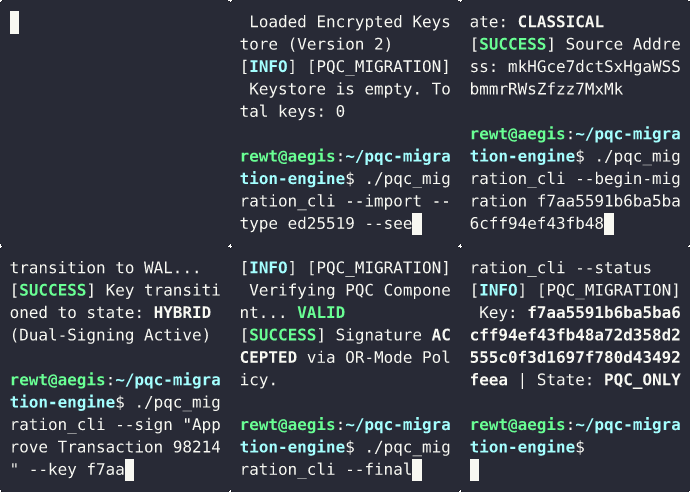
The Standard for High Assurance KMS
Disjunctive (OR Mode) Verification
Traditional PQC upgrades require dangerous, coordinated hard forks. Higgaion implements Disjunctive Hybrid Verification, allowing uncoordinated rolling updates across distributed nodes. Legacy nodes verify classical signatures (secp256k1) while upgraded shards parse ML DSA 87 signatures simultaneously without partition faults.
Erasure Before WAL Logging
Standard Write Ahead Logging (WAL) is fatally flawed for classical key destruction; a crash during the transaction can inadvertently resurrect the compromised keys from memory. By inverting the sequence to explicitly executing zero pass OPENSSL_cleanse() memory wipes prior to the finalization commit, we guarantee deterministic crash recovery. (Patent Pending).
Dual-Paradigm Encryption
Fully integrates with CNSA 2.0 mandated requirements. Under the hood, the open core cryptography SDK natively bridges post-quantum asymmetric keys (ML-KEM-1024 encapsulation & ML-DSA-87 signatures) seamlessly alongside bulletproof symmetric data layer constraints (AES-256-GCM AEAD storage encryption).
Quad Tier Formal Verification
In systems that secure billions of dollars in institutional assets, empirical unit testing is insufficient. The Higgaion Protocol Migration Engine evaluates the state invariants using a rigid, mathematically proven methodology.
1. VST Semantic Equivalence
A mathematical proof compiled directly against the exact clightgen mapped C-AST. 107 formal theorems verify execution invariants with absolute zero admitted lemmas.
2. Liveness Checking (TLA+)
Model checking comprehensively proves absence of deadlocks across heterogeneous shard states, preventing consensus derivation halts during deployment.
3. Pointer Validation (CBMC)
Bounded check analysis on the pure C implementation mathematically proves the absolute absence of memory leaks and undefined behavior up to unwind depth 25.

Contact Us
Ready to deploy mathematically proven zero downtime PQC migration infrastructure? Contact the Protocol engineering team for commercial licensing.